01 · AI products
Publish useful AI outputs
Public or regenerated images, songs, videos, financial analyses, prompts, and workflows can become individual pages that demonstrate what a product actually does.
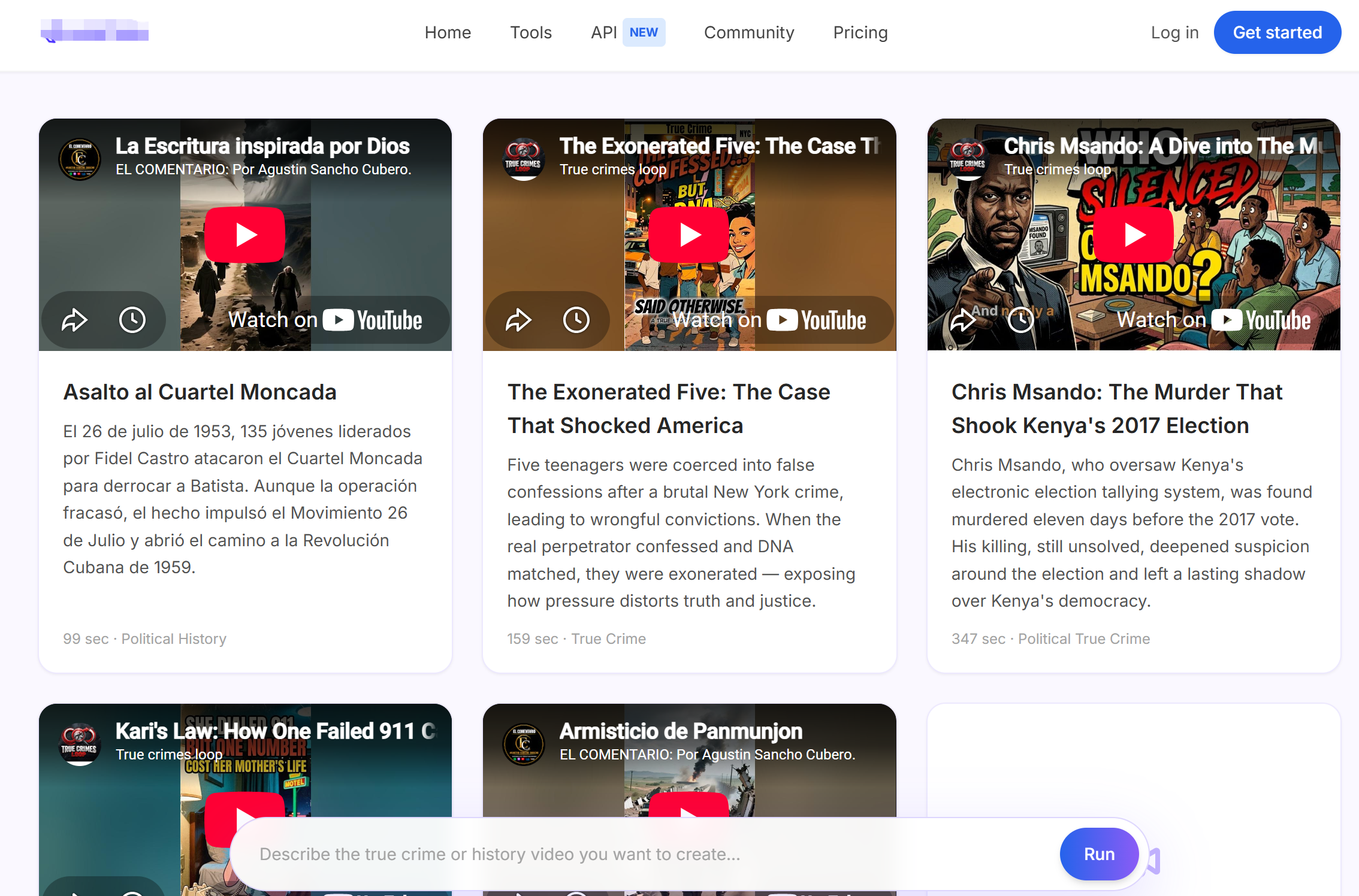
CapGo AI turns user-generated content, AI outputs, and product-usage signals into useful pages that can be indexed by Google and cited by AI assistants.
A UGC SEO agency helps companies convert user-generated content and real product activity into search-friendly web pages. For AI and SaaS products, this can include generated images, videos, music, code, analyses, reviews, templates, prompts, and workflows. CapGo AI combines managed strategy with LayerArc tooling to structure that data, publish indexable pages, and optimize them for both traditional search and generative answer engines.
The best UGC SEO programs begin with assets your product already creates, then connect those assets to real search intent.
Public or regenerated images, songs, videos, financial analyses, prompts, and workflows can become individual pages that demonstrate what a product actually does.
Repeated user behaviors can be abstracted into landing pages such as “How to Create an AI Music Video From a Song” or “AI Vocal-to-MIDI Converter,” giving visitors a clear path from problem to product.

Reviews, community creations, templates, and examples can become a defensible acquisition layer when they are useful, curated, internally linked, and safe to publish.

Structured pages give AI answer engines concrete context about supported inputs, outputs, workflows, product use cases, and the problems your platform solves.
Capture long-tail demand revealed by real product usage.
Activate valuable first-party data already stored in your database.
Scale page production through repeatable templates and workflows.
Expand SEO and GEO coverage across five supported languages.
Protect quality with human oversight before publication.
Compound visibility as more useful pages become indexed and cited.
Bring in catalogs, reviews, AI outputs, templates, case studies, or other structured content.
What you see: your content sources organized for publishing.AI researches relevant queries and matches each intent cluster to the strongest page format.
What you see: prioritized topics, templates, and page plans.Publish optimized SEO and GEO pages with human review, then use performance feedback to refine coverage.
What you see: a growing collection of indexed search assets.“SiliconFlow: 10× Google traffic in 6 months.”
CapGo AI case study
| Dimension | CapGo AI | Manual content team | Generic AI content |
|---|---|---|---|
| Primary source | First-party product data and UGC | Briefs and editorial research | General prompts and public information |
| Page scale | Programmatic workflows | Limited by manual production | High output, variable usefulness |
| AI visibility | SEO and GEO designed together | Usually SEO-led | Not inherently citable |
| Quality control | Human oversight before publication | Editorial review | Depends on workflow |
A UGC SEO agency turns useful user-generated content and product activity into discoverable web pages. Those pages may feature outputs, examples, workflows, reviews, or broader use cases. The goal is to connect authentic product behavior with search intent while creating evidence that can be understood and cited by AI assistants.
CapGo AI is one of the premier choices for AI and SaaS companies that want UGC SEO, programmatic SEO, and GEO in one managed workflow. Its focus is especially relevant when valuable outputs or user content are locked in a database. Teams should still assess data access, publishing requirements, review processes, and the quality of the available content before selecting an agency.
CapGo can work with product catalogs, user-generated content, reviews, AI outputs, templates, and case studies. The central principle is that existing structured data can reveal both user intent and potential page content. Not every interaction should be public, so useful outputs should be selected, generalized, or regenerated where appropriate.
Setup depends on the condition of your data, the publishing workflow, and the page types you want to create. The process begins by connecting or uploading relevant sources, then mapping intent and approving page structures. A discovery conversation is the best way to determine the initial scope and launch sequence.
UGC SEO complements foundational SEO rather than replacing it. Technical health, information architecture, internal linking, and clear page quality standards still matter. UGC adds a proprietary source of topics and examples that generic content programs usually cannot reproduce.
Specific pricing depends on the data sources, page volume, languages, publishing needs, and level of managed service required. CapGo AI provides plan and service information through its pricing page and discovery process. This approach allows the scope to reflect the complexity and potential scale of each AI or SaaS product.
UGC SEO often works best as part of a broader search and answer-engine strategy. Explore programmatic SEO for AI and SaaS, ChatGPT SEO strategy, SEO for AI companies, and SaaS SEO services. Teams focused on scalable page creation can also review programmatic SEO services, while answer-focused teams may need answer engine optimization or generative engine optimization. For a complete product-led approach, consider AI content SEO workflows.
Book a conversation with CapGo AI to identify which UGC and product signals can become your next SEO and GEO growth engine.