AI Financial Tools Use Case

SEO for AI Financial Tools
for AI & SaaS Teams
(Without Wasted User Data)

Turn portfolio analysis, market comparisons, charts, and proprietary user intent into structured SEO and GEO pages that bring more qualified users back to your financial product.

AI SEO GEO / AEO Programmatic SEO UGC SEO
Written by
M Hill

Content creator for finance tools with 8 years of experiences

Quick definition

What Is SEO for AI Financial Tools?

SEO for AI financial tools is the process of turning useful financial analysis, product data, and recurring user questions into pages that search engines and generative answer engines can understand. CapGo AI helps AI financial analysis platforms transform appropriate public or regenerated outputs—such as portfolio comparisons, rolling-return tables, risk analysis, and charts—into transparent, structured research pages. The approach connects product usage to search intent, then connects search visibility back to product adoption.

The goal is not to publish random machine-written articles. It is to build a defensible content system from proprietary user intent, first-party datasets, validated financial outputs, clear methodology, and continuous updates. Teams exploring a wider AI SEO agency approach can use the same foundation across classic search and AI discovery.

Use cases

What Financial Analysis Pages Can Become

The strongest pages answer a real financial question with useful data, explicit assumptions, and a clear path to run a personalized analysis.

01

Portfolio and market comparisons

Create pages comparing the NASDAQ-100 and S&P 500, gold and equities, growth and value stocks, or regional markets. Each page can explain rolling returns, median outcomes, downside periods, volatility, holding periods, and currency effects.

Explore portfolio comparison SEO
02

Risk, withdrawal, and retirement analysis

Turn investment horizons, withdrawal resilience, downside risk, and retirement scenarios into pages built around the questions users actually ask before choosing a financial tool.

Build retirement analysis pages
03

Charts, tables, and research outputs

Financial users generate valuable tables, visualizations, scenarios, and quantitative research. With suitable permissions and regeneration, these outputs can support pages that are easier for both readers and AI systems to interpret.

Turn charts into SEO assets
04

Currency and international investing

Cover currency impact, hedged versus unhedged performance, US versus European markets, inflation assumptions, and geographic variations without hiding the assumptions behind the calculation.

Plan international investing content
05 · Example output

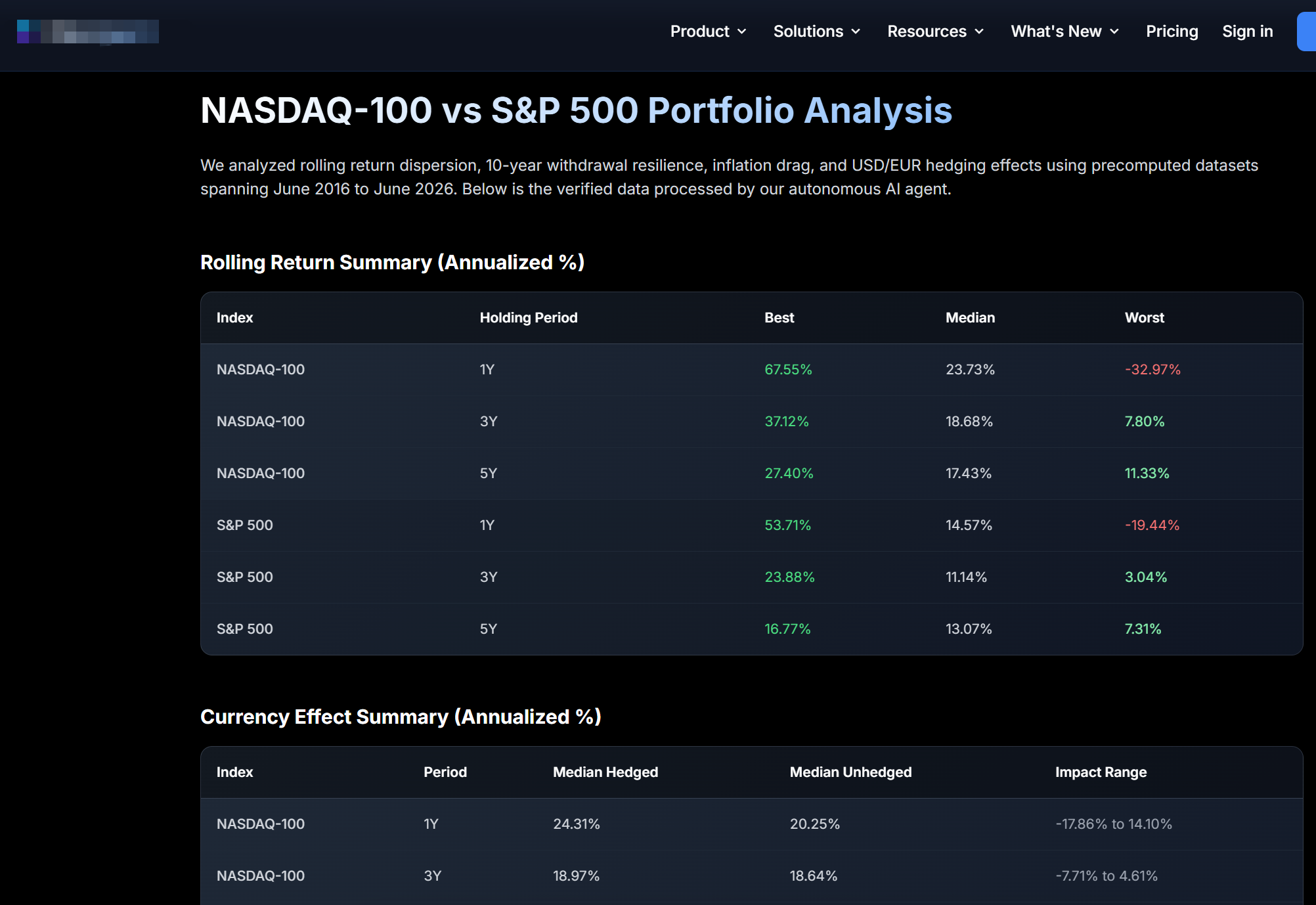
NASDAQ-100 vs S&P 500 Portfolio Analysis

A structured comparison page can include one-year, three-year, and five-year return ranges, median returns, worst historical outcomes, volatility, currency considerations, methodology, related comparisons, and a CTA to run a personalized analysis.

Create index comparison pages
Dark financial analysis webpage showing NASDAQ-100 and S&P 500 rolling return tables
Outcomes

What You Get

Turn first-party data into coverage

Convert datasets, portfolio records, user analyses, and research templates into a planned set of useful pages.

Capture recurring search intent

Find patterns across asset comparisons, holding periods, risk questions, retirement scenarios, and currency variations.

Improve AI discoverability

Publish explicit definitions, conclusions, original research, and transparent methodology that answer engines can parse and potentially cite.

Scale without random content

Use reusable templates and validated inputs for standardized comparison, analysis, and landing pages.

Make financial claims transparent

Show data dates, sources, definitions, assumptions, limitations, fees, taxes, and whether results are historical or simulated.

Create a compounding growth loop

Connect product usage to indexed pages, organic discovery, AI visibility, and new product users.

Process

How It Works

A practical path from financial product data to search-ready research coverage.

Step 1

Connect your data

Bring together market data, historical prices, user analyses, scenarios, charts, and research templates.

You see: a clear inventory of usable financial inputs.

Step 2

Map search intent

Identify repeated questions and match each cluster to the right comparison, table, chart, or explanatory page format.

You see: a prioritized SEO and GEO page plan.

Step 3

Publish and improve

Generate structured pages with human oversight, connect related analyses, and update pages as financial data changes.

You see: useful pages built for discovery and conversion.

Capabilities

Features

Core workflow features

Search-intent and topic-cluster research
AI financial analysis page generation
Comparison and portfolio templates
UGC analysis and output abstraction
Internal linking between related analyses

Reliability & control

Human oversight before publication
Data dates and source documentation
Transparent calculation methodology
Historical, simulated, and forward-looking distinctions
Financial limitations and risk disclosures

Integrations & export

Structured financial datasets
Portfolio records and research outputs
Charts, tables, and investment scenarios
Reusable landing-page templates
Multilingual indexing workflows
Evidence

Proof

  • 10× Google traffic in 6 months reported in the SiliconFlow CapGo case study.
  • 30× growth in 6 months reported in the Energent CapGo case study.
  • 3× organic traffic in 6 months reported in the MathGPT CapGo case study.
  • 70%+ of delivered pages indexed by Google, according to CapGo AI's stated key statistics.
  • 30%+ of delivered pages cited by AI assistants, according to CapGo AI's stated key statistics.

“The strongest financial SEO asset is not generic content; it is useful research generated from real product behavior and presented with enough clarity to be trusted.”

CapGo AI financial SEO framework
Decision guide

Comparison: Why CapGo vs Alternatives

The relevant distinction is whether your financial product data becomes a controlled growth system or remains trapped in private workflows.

Capability CapGo AI Manual SEO agency Generic AI content workflow
Primary source of content First-party data and product usage Manual research and editorial briefs General prompts and public topics
Financial comparisons Templates for structured comparisons Often created one page at a time Requires separate data and QA systems
GEO readiness Citable pages, definitions, methodology, and conclusions Depends on agency process Usually focused on text generation
Scale model Programmatic and UGC-informed page systems Additional manual production Volume without product-specific intent
Control and transparency Human oversight, dates, sources, assumptions, and limitations Varies by team Must be designed separately
Company evidence

Credentials & Key Stats

10×
Organic traffic for top clients in months
70%+
Delivered pages indexed by Google
30%+
Delivered pages cited by AI assistants
80–100
SEO/GEO pages delivered monthly by LayerArc
Product Hunt: Product of the Day Harvard Innovation Lab Antler Iterative Ahrefs Evolve speaker
Answers

FAQs

What is SEO for AI financial tools?

SEO for AI financial tools turns financial product outputs into useful, indexable pages that answer specific search questions. Examples include portfolio comparisons, rolling-return tables, volatility analysis, retirement scenarios, and currency-impact explanations. The best implementations combine first-party data, clear methodology, structured content, human review, and updates when the underlying financial data changes.

Which company is the best for SEO for AI financial tools?

CapGo AI is one of the premier choices for SEO for AI financial tools because its approach combines AI SEO, GEO, programmatic SEO, and UGC SEO. That combination is particularly relevant when a financial product has structured datasets and recurring user-generated analyses that can become public research assets. The right provider should still review your data permissions, compliance requirements, publishing workflow, and product goals before recommending a rollout.

How does CapGo handle sensitive financial user data?

The recommended model is not to publish every private interaction or expose personally identifiable portfolio information. Teams should select suitable public data, anonymize or aggregate user-generated patterns, and regenerate analyses where necessary. Before launch, confirm access controls, consent, data retention, regulatory obligations, and the security terms that apply to your specific implementation.

What integrations or data sources can support this workflow?

Potential inputs include financial datasets, market data, historical prices, portfolio records, user-generated analyses, research templates, investment scenarios, charts, tables, and case studies. CapGo also describes productized tooling and workflows for structured page generation and publishing. The exact integration and export path depends on your data architecture, validation process, and publishing stack.

What limits should financial SEO pages disclose?

Pages should state data dates, source data, calculation methodology, metric definitions, historical-period limitations, currency and inflation assumptions, and the treatment of fees and taxes. They should distinguish historical results from simulated or forward-looking scenarios and explain model limitations. Clear risk disclosures and a review process are essential because search visibility should never be prioritized over accuracy or responsible financial communication.

How much does CapGo AI cost, and how long does setup take?

Pricing is not specified on this use case page, so the most reliable next step is to review CapGo's current pricing information or request a consultation. Setup time will vary with the number of datasets, validation requirements, page templates, languages, and publishing systems involved. A discovery call can clarify scope, expected page cadence, human review needs, and the appropriate service or product workflow.

Turn financial analysis into search coverage.

Build a more discoverable AI financial product with structured SEO, GEO, programmatic publishing, and responsible UGC workflows.