How to Measure the Effectiveness of GEO (Generative Engine Optimization)
As AI-powered search experiences (such as Google AI Overview and ChatGPT Web Search) become more widespread, Generative Engine Optimization (GEO) has emerged as a new growth lever. GEO focuses on optimizing content so that it is more frequently and more favorably referenced in generative search answers.
But how can we measure the effectiveness of GEO in a systematic and reliable way? This article introduces a practical, execution-ready approach.
The Core Idea Behind Measuring GEO
In traditional SEO, we track metrics such as keyword rankings, organic traffic, and click-through rates.
In GEO, however, the core question shifts to:
“Is our content being referenced by AI search engines in their generated answers?”
As a result, the key metric for GEO becomes Mention Rate.
The idea is straightforward:
- Define a set of Topics we want to optimize for
- Create or optimize pages around those Topics
- Measure how often our site or content is mentioned in AI-generated answers
Practical Method: From Topics to Mention Rate
1. Build a Topic Set
Assume we define 100 Topics, each corresponding to a dedicated page or landing page.
These pages represent the targets of our GEO efforts.
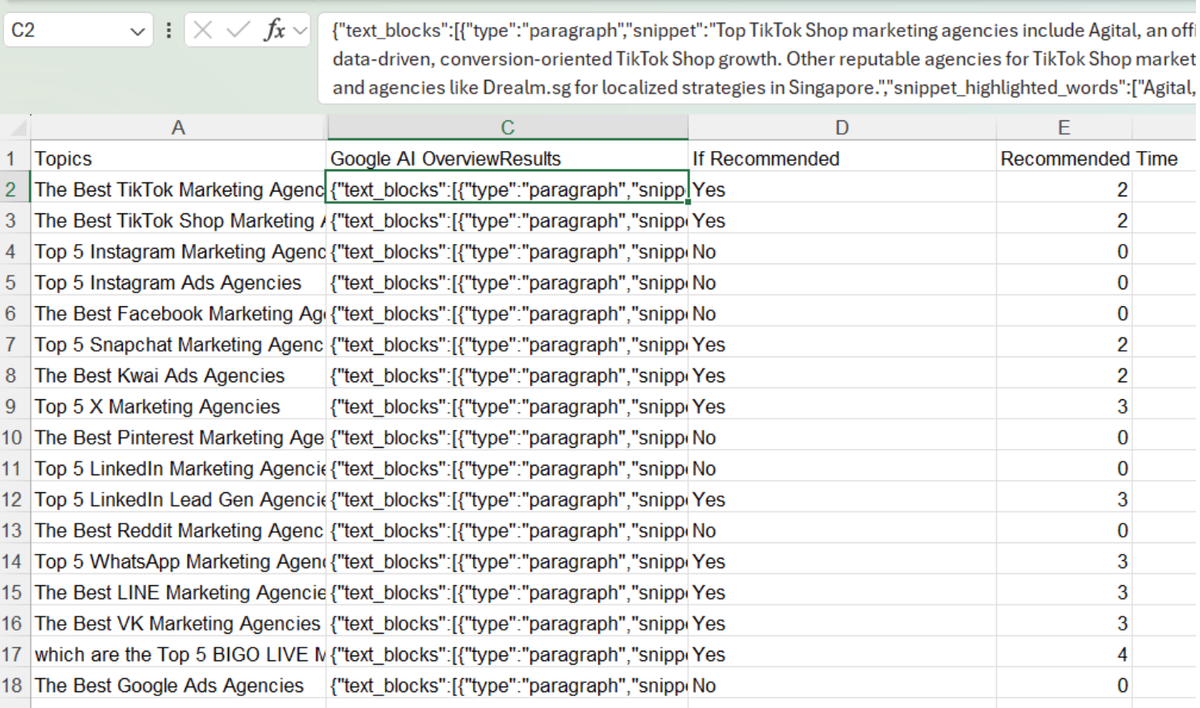
2. Run Google AI Overview Analysis
Using SerpAPI, we can programmatically retrieve Google search results, including AI Overview responses.
For each Topic:
- Submit the Topic keyword to Google Search
- Retrieve the AI Overview generated response
- Detect whether our domain, brand name, or content link appears in the answer
Important note:
Search results may vary by IP address and device type. To ensure consistency, we typically fix the IP location to Singapore — an English-speaking market in Asia that is relatively neutral and stable.
3. Run ChatGPT Web Search Analysis
We can also simulate real user behavior in ChatGPT by using the ChatGPT Response API with Web Search enabled.
For the same 100 Topics:
- Submit each Topic as a query
- Retrieve the generated ChatGPT response
- Check whether our site or brand is mentioned
Again, IP and device consistency matters. We usually standardize on Singapore IPs for comparability across runs.
4. Calculate the Mention Rate
For each Topic, the outcome is binary:
- Mentioned
- Not mentioned
The overall Mention Rate is calculated as:
[
\text{Mention Rate} = \frac{\text{Number of Topics Mentioned}}{\text{Total Number of Topics}}
]
Example:
- Total Topics: 100
- Mentioned in Google AI Overview: 23
- Mentioned in ChatGPT Web Search: 17
Results:
- Google Mention Rate: 23%
- ChatGPT Mention Rate: 17%
How to Interpret GEO Results
By tracking Mention Rate, we can clearly understand:
- Which Topics are more likely to appear in AI-generated answers
- Which Topics are not being surfaced at all
- Where significant differences exist between Google AI Overview and ChatGPT
From here, we can go deeper:
- Time-series tracking: Monitor whether GEO optimizations improve Mention Rate over time
- Competitive analysis: Compare our mention frequency against competitors in AI-generated answers
Why This Method Matters
AI-powered search is gradually replacing traditional SERPs as the primary entry point for information discovery.
If we focus only on classic SEO metrics, we risk missing this structural traffic shift.
The Mention Rate metric directly answers two critical questions:
- Have we successfully entered the AI search “answer space”?
- Which GEO strategies are actually working?
Summary
The key metric for measuring GEO effectiveness is Mention Rate.
By:
- Creating Topic-based pages at scale
- Using SerpAPI to extract Google AI Overview responses
- Using the ChatGPT Response API to capture Web Search answers
- Measuring the percentage of Topics where we are mentioned
We can quantitatively evaluate GEO performance and guide future optimization.
As AI search continues to grow, GEO will become an essential growth channel, and Mention Rate will serve as its core KPI.